Artificial Intelligence-enabled Hardware Cosmic Radiation Sensor for Space Applications (AICoRS) 2024 – 2026 contract de finanțare 2ROMD/01.06.2024
This project is implemented in collaboration with Technical University of Moldova (UTM), Chișinău, Republic of Moldova.
Funded by the Romanian Ministry of Research, Innovation and Digitalization, project PN-IV-P8-8.3-ROMD-2023-0068 entitled ”Artificial Intelligence-enabled Hardware Cosmic Radiation Sensor for Space Applications (AICoRS)”, contract no. 2ROMD/01.06.2024.
During the AICoRS project, a smart sensor for detecting cosmic radiation intended for space applications was successfully designed, built and validated. The sensor is based on FPGA technology and Artificial Intelligence (AI) models capable of identifying and classifying the effects of radiation on electronic systems in real time. A functional experimental demonstrator was developed and tested, as well as the final version of the module intended for integration onto a nanosatellite scheduled for launch into Space at the end of 2026. The tests confirmed the system’s proper functioning, the effectiveness of the mechanisms for detecting and self-correcting radiation-induced errors and the ability of the AI models to accurately classify failure patterns. At the same time, the project has contributed to training a new generation of researchers through mentoring activities and research internships conducted in collaboration between Romania and the Republic of Moldova. The results obtained demonstrate the feasibility of using modern, affordable, and energy-efficient electronic technologies for monitoring cosmic radiation and increasing the reliability of future space missions.
Romanian version:
Pe parcursul proiectului AICoRS a fost proiectat, realizat și validat cu succes un senzor inteligent pentru detectarea radiației cosmice destinat aplicațiilor spațiale, bazat pe tehnologie FPGA și modele de Inteligență Artificială (IA) capabile să identifice și să clasifice în timp real efectele radiațiilor asupra sistemelor electronice. A fost dezvoltat și testat un demonstrator experimental funcțional, precum și varianta finală a modulului destinat integrării pe un nanosatelit ce urmează să fie lansat în spațiu la sfârșitul anului 2026. Testele efectuate au confirmat funcționarea corectă a sistemului, eficiența mecanismelor de detecție și autocorecție a erorilor produse de radiații, precum și capacitatea modelelor IA de a clasifica cu precizie tiparele de defecțiuni. În paralel, proiectul a contribuit la formarea unei noi generații de cercetători prin activități de mentorat și stagii de cercetare desfășurate în colaborare între România și Republica Moldova. Rezultatele obținute demonstrează fezabilitatea utilizării unor tehnologii electronice moderne, accesibile și eficiente energetic pentru monitorizarea radiațiilor cosmice și creșterea fiabilității viitoarelor misiuni spațiale.
Executive summary: The AICoRS project aims at designing, implementing and validating an experimental model of a Cosmic radiation sensor (Single Event Upset detector) for Space applications (TRL 4). The sensor will be implemented in hardware, on a Field Programmable Gate Array (FPGA) and it will benefit of a hardware implementation of an Artificial Intelligence model for the real-time, on-the-fly analysis of the radiation-induced faults patterns in the satellite-embarked electronics. In the process, the young researchers involved in the project, especially the ones from UTM, will be trained, mentored and supported for their advancement in the PhD programs and academic careers. This will be achieved through the appropriate planned mobilities (exchanges) of the early-stage researchers between Romania and Republic of Moldova. The project scope will be achieved in tight collaboration between the team members from UNITBV and UTM and the complementarity of their existing infrastructure.
Goal: The AICoRS project aims at designing, implementing and validating an experimental model of a cosmic radiation sensor (Single Event Upset detector) for Space applications (at TRL 4), which will be implemented in hardware, on an FPGA and it will benefit of a hardware implementation of an AI model for the real-time, on-the-fly analysis of the radiation-induced faults patterns in the satellite-embarked electronics. In the process, the young researchers involved in the project, especially the ones from UTM, will be trained and supported for their advancement in the academic careers. This will be achieved through the appropriate mentoring and planned mobilities (exchanges) of the early-stage researchers between Romania and Republic of Moldova. The project scope will be achieved in tight collaboration between the researchers from UNITBV and UTM and the complementarity of their existing infrastructure.
The AICoRS project has the following objectives in order to achieve the previously-declared scope:
O1. Design, implementation and validation of the AICoRS experimental model (TRL 4), which is the FPGA-based implementation of the AI-enabled hardware Cosmic radiation sensor for Space applications;
O2. Training the early-stage researchers involved in the AICoRS project;
O3. Exploitation of the research infrastructure complementarity between UNITBV and UTM;
O4. Dissemination of scientific results in international peer-reviewed journals and conferences and, last but not least,
O5. Coordination and management for the successful project implementation.
Project team
UNITBV: prof. dr. ing. Mihai Ivanovici, s.l. dr. ing. Stefan Popa, drd. ing. Artur Kazak
UTM: conf. dr. ing. Irina Cojuhari (conf. dr. ing. Nicolae Secrieru), dr. ing. Mariana Rusu, dr. ing. Viorel Cărbune, drd. ing. Vladimir Melnic, drd. ing. Tudor Zadorojneac, drd. ing. Adrian Bîrnaz
Project activities and results
Activity 2.1 – Design, implementation and validation of the AICoRS experimental model (O1)
Figure below shows the final version of the nanosatellite module that implements the AICoRS system, adapted for the integration on the BIRDS-RPM nanosatellite (left- bottom view, right – top view).
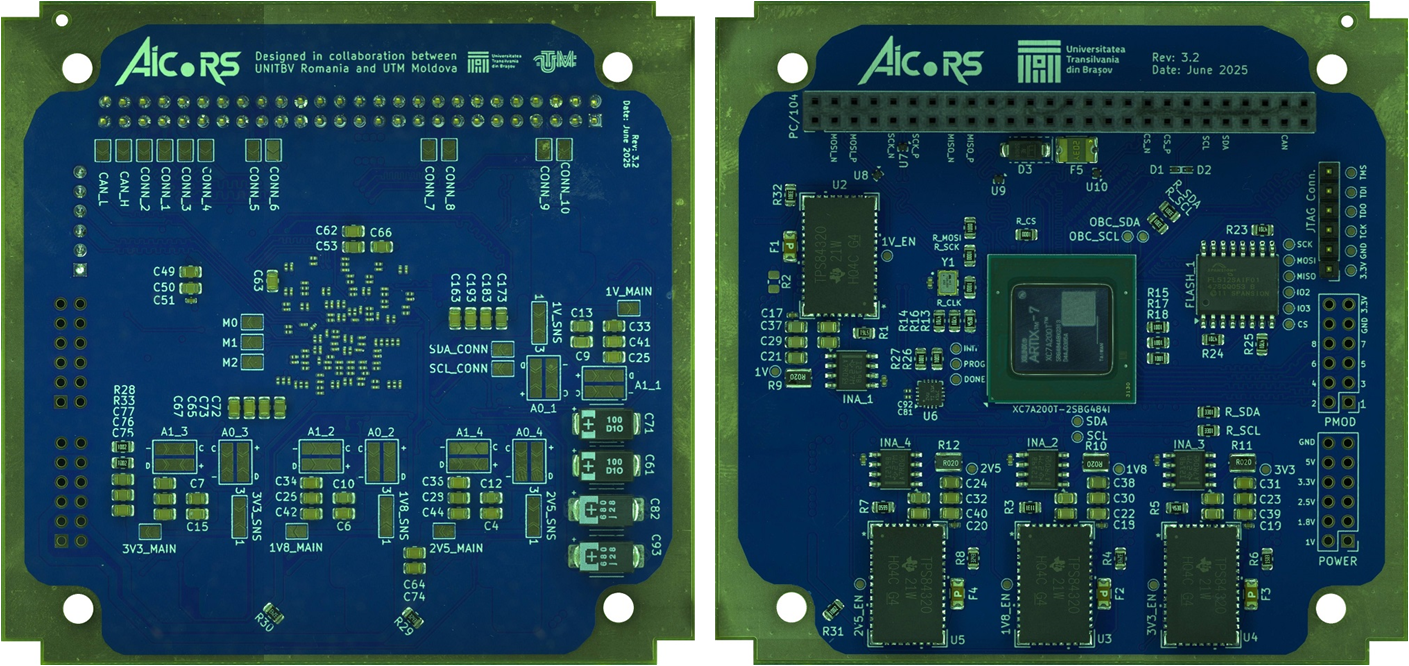
Fig. The AICoRS nano-satellite module (experimental demonstrator) that will fly in Space in 2026.
Activity 2.2 – Training of Young Researchers (O2)
Activity 2.2 resulted in the training and support of young researchers involved in the project through mentoring activities and research internships conducted in collaboration between UNITBV and UTM, contributing to the development of their skills in the field of electronic systems and space applications.
Activity 2.3 – Long-term strategic partnership (O3)
The activity focused on the joint use of research infrastructure available at UNITBV and UTM.
Activity 2.4 – Dissemination and communication (O4)
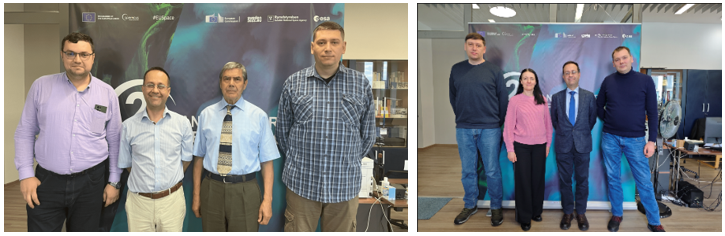
The Keek-off Meeting took place on 4th July 2024: https://utm.md/blog/2024/07/05/lansarea-proiectului-bilateral-aicors-utm-si-unitbv-colaboreaza-pentru-a-dezvolta-un-senzor-avansat-de-radiatii-cosmice/
1. S. Popa, A. Kazak, A. Dinu, M. Ivanovici, N. Secrieru, V. Carbune, V. Melnic, „Architecture and Design Choices for an AI-Enabled FPGA-Based Cosmic Radiation Sensor”, 16th International Symposium on Electronics and Telecommunications (ISETC’24), Timișoara, România, 7-8 November, 2024; https://doi.org/10.1109/ISETC63109.2024.10797366
2. N. Secrieru, V. Carbune, T. Zadorojneac, V. Melnic, M. Ivanovici, S. Popa, A. Kazak, „The architecture of nanosatellite module for FPGA-based cosmic radiation sensing with artificial intelligence”, 13th International Conference on Electronics, Communications and Computing (ECCO-2024), Chișinău, Republica Moldova, 17-18 October, 2024; https://ibn.idsi.md/ro/vizualizare_articol/223204
3. N. Secrieru, V. Cărbune, T. Zadorojneac, V. Melnic, A. Bertescu, M. Ivanovici, S. Popa, A. Kazak, “Architecture of the space radiation sensor satellite module based on artificial intelligence”, Journal of Engineering Science 2024, XXXI (4), pp. 73-83. https://doi.org/10.52326/jes.utm.2024.31(4).05
4. A. Bertescu, S. Popa, “The Design and Implementation of an FPGA-Based Cosmic Radiation Sensor PCB,” 18th International Conference on Engineering of Modern Electric Systems (EMES), Oradea, Romania, 29-30 May 2025, pp. 1-4, https://doi.org/10.1109/EMES65692.2025.11045622
5. V. Bostan, N. Secrieru, M. Ivanovici, I. Cojuhari, A. Pandele, Ş. Popa, V. Melnic, N. Magariu, A. Martîniuc, “Research space missions developed at the TUM Space Centre,” IEEE International Black Sea Conference on Communications and Networking (BlackSeaCom), Chisinau, Republic of Moldova, 23-26 June 2025, https://doi.org/10.1109/BlackSeaCom65655.2025.11193922
6.S. Popa, A. Bertescu, C. Furtună, A. Kazak, M. Ivanovici, A. Martiniuc, V. Carbune, V. Melnic, N. Secrieru, “Power and Cross-Section Optimization for an FPGA-Based Cosmic Radiation Sensor”, 32nd IEEE International Conference on Electronics, Circuits and Systems (ICECS), Marrakech, Morocco, 17-19 November 2025, https://doi.org/10.1109/ICECS66544.2025.11270486
7.A. Kazak, S. Popa, A. Bertescu, M. Ivanovici, „AI-based Classification of Simulated Cosmic Radiation Bit Upsets into the SRAMs of a Commercial-grade FPGA”, submitted to the SPAICE (AI in and for Space) 2026 international conference organized by the European Space Agency (ESA), under review,
8. A. Kazak, S. Popa, A. Bertescu, M. Ivanovici, „Simulated On-board AI-based Classification of Radiation-induced SRAM Event Upsets”, submitted to MDPI Electronics, under review,
9.S. Popa, A. Bertescu, C. Furtună, M. Ivanovici, „Radiation-Tolerant Embedded Platform for Real-Time SEU Detection and Classification”, submitted to IEEE TRANSACTIONS ON NUCLEAR SCIENCE, under review.
The potential impact of the AICoRS project – it enables the increased usage of relatively-cheap FPGA-based hardware solutions for Space applications, proving the robustness of such solutions and increasing their adoption for real applications. The resulting AICoRS intelligent radiation sensor will be embarked on the BIRDS-RPM nano-satellite, as an experimental payload, and launched by JAXA (Japan Space Agency) by the end of 2026. This will allow testing the system in real-life Space conditions and collect useful data about the Cosmic radiation patterns along the satellite’s orbit.
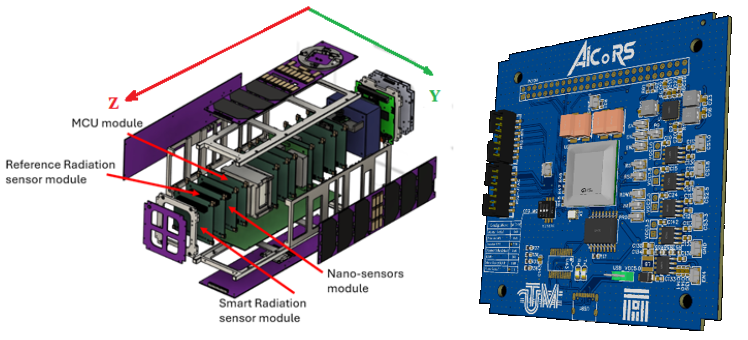
The structure of the 3U BIRDS-RPM nanosatellite, which will carry the AICoRS smart sensor developed in collaboration between UNITBV and UTM and is scheduled to be launched into orbit by JAXA in late 2026.